

Cycling Training in Autumn: How Not to Lose Your Fitness (and Start Stronger Next Year)
September marks the end of summer. Long weekend rides, miles accumulated without overthinking, legs that almost always responded, all of this gives way to something different: shorter days, dropping evening temperatures, and the question every cyclist asks at a certain point in the season: how do I train now?
The short answer is: differently. The long answer is worth telling.
Why Autumn Sets the Tone for Next Year
Anyone who has been riding for a few years knows: winter isn't built in December. It’s built right now, in these weeks when the temptation is to slow down until you stop completely, thinking "the season is over anyway." It’s a mistake you pay for in March, when you start back from zero instead of from a solid foundation.
Autumn is the time to consolidate, not to push. The year's races and tours are behind you, and performance pressure relaxes: it’s the ideal window to work on things you always put off during the summer, such as pedaling technique, position on the saddle, or (an essential foundation) basic endurance at mild intensity.
Training: What Changes Compared to Summer
With fewer daylight hours and lower temperatures, the logic of high volume and pushed intensity gives way to a more measured approach:
- Fewer hours, higher quality. Shorter rides with a precise objective: cadence, strength on heavy gears, pacing management on climbs, rather than accumulating miles for their own sake.
- More attention to recovery. In colder temperatures, the body expends more energy just to keep warm. Recovery days must be respected with the same discipline as hard rides, not sacrificed to "make up for lost miles."
- The indoor trainer comes in handy. It’s not a compromise: on short days or when daylight fades early, a targeted hour on the smart trainer (with specific threshold or cadence work) is often worth more than two uncertain hours on wet, dark roads.
- Watch your nutrition. As temperatures drop, the feeling of thirst decreases, but fluid requirements remain nearly unchanged: this is the most common oversight for autumn cyclists, but fortunately, the easiest to fix.
Dressing for the Coming Cold: The Rule of Layers
The most common mistake in this season isn't training too much or too little: it's dressing poorly. Early morning temperatures and those at two in the afternoon can differ by ten degrees Celsius, and your clothing must be planned accordingly.
The right approach is layering rather than a single heavy garment: a breathable base layer against the skin, an insulating mid layer, and a wind and water-resistant outer layer that's easy to shed and pocket as it warms up. Hands and feet deserve special attention (they are the first extremities to suffer from the cold), while a windproof vest often makes the difference between an enjoyable ride and an early return.
And it’s worth remembering Eddie Merckx’s rule: "If you set out on your bike for a training ride and, as soon as you step out of the house, you don’t feel at least a little bit cold, it means you’ve dressed too warm..."
Visibility: The Other Side of the Coming Cold
There is an aspect that tends to be understated compared to technical apparel, and that is visibility. As sunset arrives earlier week by week, it happens more frequently that you find yourself riding in uncertain daylight, such as late morning dawn or dusk arriving while you're still mid-ride. Front and rear lights fully charged, clothing with reflective inserts, and whenever possible, a route that avoids heavily trafficked roads during low-visibility hours are not an excess of caution: they are the difference that determines whether an autumn habit continues or gets interrupted by an avoidable setback.
Post-Summer Bike Maintenance: The Essential Checklist
A season full of miles leaves marks that are easily ignored in summer amidst the flow of rides. Autumn is the time to stop and inspect before cold and dampness worsen what could have been prevented:
- Chain and drivetrain. Months of dust, sweat, and hasty washes wear down the chain more than it seems: checking chain stretch prevents having to replace the cassette and chainrings later on.
- Brake pads and cables. With the first autumn rains, efficient brakes cease to be a detail.
- Tire pressure and wear. Wet surfaces reduce grip: tires worn out during the warm season should be evaluated with greater care now.
- End-of-season service. Before storing the bike for long periods, or before the year's final bike trip, a complete overhaul is well worth it: it's the simplest way to start ready and fresh next spring.
An Opportunity to Step Out of Routine
Autumn is also the season when it's worth breaking away from the road routine. A gravel bike on light dirt tracks, a few mountain bike rides on local singletracks, or even an occasional run to train the cardiovascular system differently, without forgetting cyclocross, which lets you appreciate mud by turning it into fun play. Variety during this period is not a distraction from your main goal; it is almost always a way to train muscles and joints that the repetitive gesture of road pedaling tends to leave behind. Many experienced cyclists return stronger in March precisely because, in autumn, they allowed their bodies to work on different motor patterns instead of repeating the same movement to the point of boredom.
The same applies to the context: changing your usual routes, exploring an area you've never ridden, or reversing the direction of a loop you've done the same way for years. These are small adjustments that cost nothing and bring back something that is often missing at the end of summer: the curiosity to step out the door.
How Many Rides a Week and How to Structure Them
You don't need a pro-level plan to navigate autumn well: two or three weekly rides with a clear purpose are enough, ideally alternating a more demanding session (threshold, short intervals, a fast group ride) with one or two long low-intensity rides, the kind where you can still chat while pedaling. It is in this second type of ride, often underestimated, that you build the aerobic base upon which everything else will be built next year.
Those who train with this regularity, even while reducing volume compared to summer, arrive in January with a foundation that those who stopped completely simply don't have. It’s not a matter of talent: it’s a matter of consistency, and it’s perhaps the only variable in training that truly depends solely on us.
Staying Motivated When Daylight Fades
The hardest part of autumn for many isn't physical: it's mental. Heading out as darkness arrives early requires a different motivation than in June, when all it took was opening the front door.
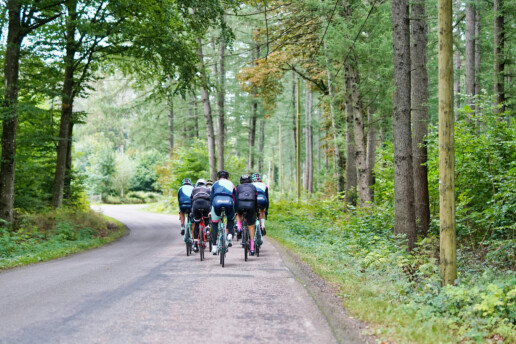
Here, setting small, concrete goals helps (a route you’ve never taken, an elevation gain to improve, a group to ride with on Saturday morning instead of solo) rather than chasing summer's explosive fitness. Riding in company during this period is worth double: a fixed group appointment is often the only thing that gets you out of the house when the couch is more tempting than usual. Above all, it helps to remember why you ride: not just for the time on the GPS, but for that exact moment when effort transforms into satisfaction. The same feeling you seek in June, just achieved with a bit more discipline.
Gaudens Cycling: One Season Ends, Another Is Prepared
Every self-respecting cycling travel season ends with the same question: where are we going next time? Autumn is when the new year's tours begin to take shape: destinations are defined, spots open up, and the first cyclists confirm their participation. Those who train methodically now arrive at the next departure with ready legs, instead of having to recover lost months in the final weeks before the trip.
It is also the most honest time to take stock of the season just closed: which climbs surprised you, which rides remained just an idea, which destination stayed in the back of your mind for a long time without ever becoming a reservation. November and December pass quickly: those who decide now arrive next spring with a tour already chosen, not with an intention postponed once again.
Are you already thinking about your next cycling trip? Write to us: we’ll tell you what we have planned for 2027
