Cycling for All Ages: The Sport That Stays With You for Life
There is a scene that anyone who has ever ridden up an Alpine climb knows all too well. You’re midway through a hairpin bend, breathless and with your legs protesting. And then you get passed, with a friendly greeting, by a gentleman with white hair and a pedal stroke as smooth as a metronome. No rush, no visible effort. Just years of miles in his legs.
This isn’t an exception. It is one of the most beautiful truths about cycling: it is one of the very few sports that never asks you to stop.
A Sport Without an Expiration Date
There are few sports that can be practiced continuously from your twenties well into advanced age. Swimming is one of them. Cycling is the other major protagonist of this exclusive club.
The most widely cited example is Robert Marchand, a French amateur cyclist who, in 2017, at 105 years old, covered 22.5 kilometers in one hour on the track at the Saint-Quentin-en-Yvelines velodrome. An extreme case, certainly. But it reveals a fundamental truth: the bicycle sets no age limit. Age limits, if anything, are set by health and motivation.
And motivation, for those who have spent a lifetime pedaling, is rarely lacking.
Gentle on the Body: Why Cycling Doesn’t Demand a Heavy Toll
The secret to cycling longevity lies entirely in the movement itself. Pedaling is a circular, fluid, continuous motion. Body weight is supported by the saddle, and joints work without enduring hard impacts.
Comparing cycling to running is instructive. When you run, with every stride the body absorbs an impact force equal to two or three times its own weight. Multiplied over thousands of steps, this repeated strain creates microtraumas in the ankles, knees, hips, and lower back over time. That is why many runners, past a certain age, are forced to reduce their mileage or change disciplines.
Then there are contact sports, where injury risk is part of the game. Soccer, basketball, rugby, martial arts: extraordinary sports, but ones that become increasingly difficult to sustain as the years go by.
Cycling has none of this. No ground impact, no tackles, no heavy blows. Just a movement that, if the bike is properly fitted, the body can repeat for hours without paying the price the next day. For this reason, it is often recommended to people with worn joints or those returning to activity after a period of rest.
Meanwhile, cyclists do not rely on running as a core training element, let alone during rehabilitation: they already have what they need, equally effective and without trauma. In fact, many major rugby teams, both club and national, place spin bikes on the sidelines during matches for bench players to warm up, keeping them ready to enter the game quickly at a moment’s notice. That is no coincidence.
Pay close attention: athletes in any sport involving running occasionally pedal (even if only on an indoor spin bike) or swim in a pool, even if just for functional rehabilitation or physical therapy after an injury.
The Last Ones to Step Off the Saddle
Just look around. In a group of friends who spent years doing sports together, who is still out training when everyone else has hung up their shoes? Very often, it is the cyclist.
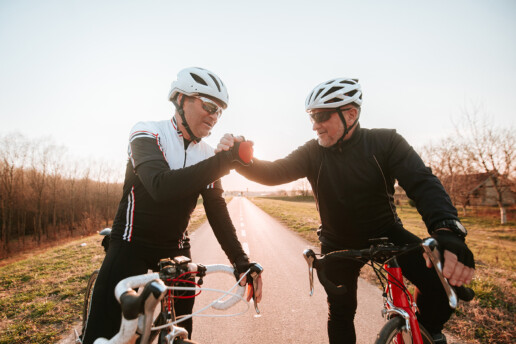
The weekend soccer player quits because of their knees. The tennis player because of their shoulder. The runner because of their Achilles tendon. Meanwhile, the cyclist keeps heading out on Saturday mornings with their group, perhaps riding a few fewer kilometers and enjoying a few more coffee stops along the way.
It is not a matter of talent or genetics. It is simply that the bicycle allows you to adapt the effort to your physical condition, year after year, without having to give it up.
Everyone at Their Own Pace
And here lies the true virtue of cycling, setting it apart from almost every other sport: outside of competitive racing, there is no mandatory pace.
In a soccer match, you have to run when the ball moves. In a running race, the stopwatch is unforgiving. On a bicycle, however, you decide. You can attack a climb all-out, chasing a personal record on Strava. Or you can climb with agility, using a light gear, chatting with the person pedaling beside you and taking in the scenery as it unfolds, hairpin after hairpin.
Both choices are legitimate. And both get you to the top.
Experienced cyclists know this well: true cycling maturity is not measured in watts, but in the ability to listen to yourself. In knowing when to push and when to let it roll. Souplesse, that fluid and efficient pedal stroke that the French turned almost into a philosophy, is often an achievement of maturity, not youth.
Technology helps too. Modern bikes offer very versatile gear ratios, designed specifically to tackle challenging inclines without over-revving. Climbing an Alpine pass no longer requires professional legs: it requires the right combination of gears, rhythm, and patience.
Nobody is asking you to ride to exhaustion. Amateur cycling is, above all, a pleasure.
Everyone at Their Own PaThree Tips for Riding Longer and Betterce
Pedaling for a lifetime is possible, but it requires a bit of intelligence. Here are three tips worth following at any age.
1. A sports medical checkup is not a formality. Especially after age forty, a cardiovascular checkup with a stress ECG is the simplest way to ride with peace of mind. Knowing your heart rate zones also allows you to train better.
2. A bike fitted to you. An incorrect riding position is the primary cause of knee, back, and neck discomfort. A professional bike fitting, or at least a careful adjustment of saddle height, setback, and handlebar reach, makes the difference between an enjoyable ride and one remembered for backache.
3. Cross-training matters. Precisely because it involves no impacts, cycling places minimal stress on bones. To maintain good bone density over time, it is wise to complement cycling with lightweight strength training or weight-bearing activities, such as walking and gym work. Your doctor or trainer can guide you toward the right balance.
Three small investments that pay off in years of extra miles.
EvThe Dream Route, at Your Pace: Custom Tours by Gaudenseryone at Their Own PaThree Tips for Riding Longer and Betterce
Every cyclist has a climb they dream of. The Tourmalet, the Stelvio, the Flemish cobbles, the Pico del Veleta. But between the dream and reality, doubts sometimes creep in. Will I make it? Will the group ride too fast? What if a stage is too long for me?
It is precisely to answer these questions that Gaudens Cycling organizes tailor-made tours, built around the needs and capabilities of each participant.
We don’t start with a pre-packaged tour. We start with you: your experience, your fitness level, how much you want to pedal each day, and what you want to see. Based on this, we calibrate daily mileage, elevation gain, recovery times, and rest stops. If a day features a challenging climb, we can provide shorter route options for those who prefer to conserve energy, without missing out on reaching the summit.
And during the journey, you are never alone. The support van follows the route with a mechanic, spare parts, and luggage. If fatigue sets in, or if a day isn’t going right, there is always a solution. No anxiety about falling behind, no fear of not making it.
Our custom tours are also designed for small groups of friends—four or five people with varying fitness levels who want to share the same adventure. Fitter riders can extend the route, while those who prefer a relaxed pace can enjoy the road at their leisure. And in the evening, everyone sits at the same table, sharing stories of the day over a fine glass of wine.
Because in the end, after many years in the saddle, you realize one simple thing: nobody remembers the average speed. Everyone remembers the summit, the road, and the people they shared it with.
The Road Awaits. At Your Pace.
Whether you are thirty or seventy, whether you have been pedaling all your life or recently picked up cycling, there is a trip that is right for you. It just needs to be built the right way.
Tell us about your dream climb. We’ll handle the rest.
Potrebbe interessarti...
Cycling Training in Autumn: How Not to Lose Your Fitness (and Start Stronger Next Year)
How to train on a bike in autumn: workload management, layer dressing, post-summer bike maintenance, and tips to stay…